
Apartmentality
An Apartment State Of Mind

10 Best Neighborhoods in the Boston Area for Renters (2026 Guide)
September 23, 2026
The Boston area brings together historic city districts, major universities, waterfront destinations, employment centers, and suburban communities with more room to spread out. Renters can choose a brownstone near central Boston, an apartment close to Cambridge’s research and technology hubs, or a newer community outside of the city with direct highway or commuter rail connections.
That range is useful in a competitive rental market, but it also means the best location depends on what matters most to you. Budget, transportation, apartment style, nearby employers, dining, parks, and everyday services can all shape the decision. These 10 Boston-area neighborhoods and communities offer some of the strongest combinations for renters in 2026.
1. Cambridge
Cambridge sits directly across the Charles River from Boston and combines several distinct districts in one compact city. Harvard Square centers on bookstores, restaurants, performance venues, and Harvard University. Central Square adds live music and a broad mix of dining, while Kendall Square is one of the region’s leading life-sciences and technology employment hubs. Museums, university programming, and community events keep the calendar full throughout the year.
Rental housing ranges from apartments in older multifamily buildings to converted homes, condominiums, and newer mid-rise communities. Inventory and pricing can vary significantly between Harvard, Central, Kendall, Porter, and Alewife. Cambridge is generally one of the Boston area’s more expensive rental markets, but renters often accept the premium for proximity to major employers, educational institutions, and an unusually broad mix of daily services.
Cambridge has six Massachusetts Bay Transportation Authority (MBTA) stations accessing the Red and Green Lines, along with extensive bus service and a commuter rail station. The transit network makes Boston, Somerville, and other nearby employment centers accessible without relying on a single mode of transportation. Renters should still compare the specific square and station nearest each apartment, because the experience can change considerably from one part of Cambridge to another.
2. Allston–Brighton
Allston and Brighton share a city district but offer different atmospheres. Allston is known for music venues, international dining, and the activity surrounding Harvard Avenue and Boston University. Brighton becomes more residential around Brighton Center and Oak Square, with local restaurants, neighborhood services, and quieter side streets. Together, they form one of Boston’s most rental-oriented areas and offer a wider range of price points than many central neighborhoods.
The housing mix includes triple-deckers, converted homes, established apartment buildings, and newer communities along the major corridors. Apartments in older buildings may offer character and more varied layouts, while newer options tend to include updated finishes and shared amenities. Competition is still common, particularly near transit and university campuses, but renters often find more inventory here than in Back Bay or central Cambridge.
MBTA Green Line service, commuter rail access from Boston Landing, and multiple bus routes connect the area with Downtown Boston, Cambridge, and nearby employment centers. Interstate 90 also runs along the district’s northern edge. Allston–Brighton is a practical choice for renters who want neighborhood dining, entertainment, and rental variety while remaining connected to the rest of the city.
3. Back Bay
Back Bay is one of Boston’s most recognizable neighborhoods, shaped by Victorian brownstones, Commonwealth Avenue, Newbury Street, and the Prudential Center. The Boston Public Library, Copley Square, the Charles River Esplanade, and a concentration of restaurants and shops are some of the city’s best-known destinations, all located close together here in the Back Bay. The neighborhood’s central location is also within convenient reach of Downtown, the South End, Fenway, and the Seaport.
Renters can choose from apartments inside historic brownstones, established high-rise buildings, and newer luxury communities. Space can be limited in older homes, and prices in this area typically sit near the top of the regional market. In exchange, the neighborhood offers an extensive mix of services, cultural institutions, and transportation options. Renters comparing listings should pay close attention to building age, storage, laundry, elevator access, and parking arrangements. Back Bay is best suited to renters who place a premium on a central address, classic Boston architecture, and direct access to shopping, dining, and cultural destinations.
4. Somerville
Somerville sits north of Cambridge and Boston and is organized around neighborhood centers such as Davis Square, Union Square, and Assembly Row. Davis Square is known for restaurants, entertainment, and the Somerville Theatre. Union Square brings together local food businesses, creative spaces, and community events, while Assembly Row offers newer apartments, retail, dining, and proximity to the Mystic River.
Housing includes triple-deckers, converted homes, smaller apartment buildings, and new mid-rise communities near transit stations. Rental demand is strong in Sommerville, and pricing can approach Cambridge levels in the most sought-after locations. Renters may find more variety farther from Davis and Union Squares, although transportation and parking needs should be carefully considered.
The Red Line serves Davis Square, the Green Line Extension reaches Union Square and eastern Somerville, and the Orange Line stops at Assembly. Bus routes add connections to Cambridge and Boston. This transit combination makes Somerville a strong choice for renters who want local businesses, arts and entertainment, and several ways to reach the region’s major employment centers.
5. Chelsea
Chelsea is located just across the Mystic River from Boston and combines a compact downtown, waterfront parks, historic architecture, and a growing collection of contemporary apartment communities. Restaurants and local businesses reflect the city’s broad cultural mix, while Mary O’Malley State Park and the Admiral’s Hill area add open space and waterfront views. Downtown Boston and Logan International Airport are minutes away.
Chelsea’s housing ranges from triple-deckers and converted homes to newer apartment communities, giving renters more variety than many central Boston neighborhoods. Those interested in contemporary options near the waterfront or transit can also explore Axis Admiral’s Hill Apartments, V2 Apartments, and Vero Apartments—Fairfield communities located in different parts of the city.
The Silver Line, commuter rail, and bus routes provide connections to Downtown Boston, the Seaport, East Boston, and other parts of the metro. Route 1 also runs through the city for regional driving access. Chelsea earns its place on this list by combining proximity to Boston with substantial apartment inventory and multiple transportation choices.

6. Fenway–Kenmore
Fenway–Kenmore places renters close to some of Boston’s most recognizable cultural, educational, healthcare, and entertainment destinations. Fenway Park, the Museum of Fine Arts, Symphony Hall, and the Back Bay Fens are all in or beside the neighborhood. The Longwood Medical and Academic Area is the densest cluster of research activity in the country, comprising several colleges and universities, and supports a steady neighborhood rhythm beyond games and concerts.
This is one of Boston’s most renter-oriented sectors, with apartments ranging from compact homes in established buildings to newer mid-rise and high-rise communities. Demand is high, and rents often exceed the citywide average. Event schedules can add activity around Fenway Park and Kenmore Square, so it’s a good idea to compare the atmosphere and transportation patterns at different times. Fenway–Kenmore works especially well for renters who want cultural institutions, major employers, and entertainment close by and who are comfortable with the energy of a busy central district.
7. Woburn
Woburn offers a suburban setting north of Boston with access to major employment and retail centers across the Route 128 corridor. Woburn Village, nearby Burlington, and the surrounding commercial districts provide restaurants, shopping, and everyday services. Residential areas range from established streets to newer apartment communities, giving renters options beyond the denser neighborhoods closer to the city center. Renters drawn to the Anderson/Woburn Station area can also explore Station 316 Apartments, a Fairfield community with easy access to commuter rail, I-93, and I-95.
Woburn is a practical choice for renters who want contemporary apartment amenities, suburban services, and connections to Boston, Cambridge, Burlington, and North Shore employment centers without living amidst the city.
8. Peabody
Peabody extends the search toward the North Shore, where renters can stay near Salem, Beverly, and employment centers along I-95 and Route 128. Northshore Mall and the surrounding commercial areas provide a substantial concentration of shopping, dining, and services. Downtown Peabody adds local businesses and community events, while nearby coastal destinations expand weekend options.
Peabody’s rental options include apartments in established buildings and contemporary communities, giving renters alternatives to the region’s older housing stock. Those interested in a newer option near shopping, dining, and North Shore road connections can explore Jayden Apartments, a Fairfield community in Peabody.
Most trips from Peabody rely on regional roads or connections to nearby transit. For those who want North Shore access, modern apartment features, and more separation from central Boston’s density, Peabody can be a strong Boston-area option.
9. Jamaica Plain
Jamaica Plain, often called JP, offers a balance of neighborhood activity and access to some of Boston’s largest green spaces. Centre Street and South Street are home to restaurants, cafés, shops, and community organizations. Jamaica Pond, the Arnold Arboretum, Franklin Park, and other parts of the Emerald Necklace create a broad network of outdoor destinations close to residential areas.
Options for renters include triple-deckers, Victorian homes divided into apartments, condominiums, and newer apartment buildings near the major corridors. Some renters choose JP for more space than the most central neighborhoods, while still having access to local dining, cultural events, and everyday services.
Orange Line stations at Jackson Square, Stony Brook, Green Street, and Forest Hills serve different parts of the neighborhood, supported by several bus routes. JP is a strong fit for those who value green space and an established neighborhood center without leaving Boston.
10. Andover
Andover combines a historic town center with access to northern Massachusetts employment hubs. Downtown Andover includes restaurants, local shops, and cultural destinations, while Phillips Academy and the Addison Gallery of American Art contribute year-round programming. I-93 and I-495 connect the area with Boston, the Merrimack Valley, and technology and healthcare employers throughout the northern region.
Andover’s rental options range from homes and smaller multifamily buildings to newer apartment communities. Renters who value access to the town center, commuter rail, and northern employment hubs can explore Fairfield’s The Slate at Andover Apartments.
Andover and Ballardvale commuter rail stations provide another connection toward Boston, while driving remains important for many regional destinations. Andover is the broadest metro-area choice on this list, but it earns a place for renters prioritizing a suburban setting, contemporary apartment amenities, and access to northern employment centers.
Neighborhoods Comparison
The right Boston-area neighborhood depends on how you balance location, transportation, apartment style, nearby destinations, and budget. This comparison highlights the defining strengths and key considerations for all 10 options.
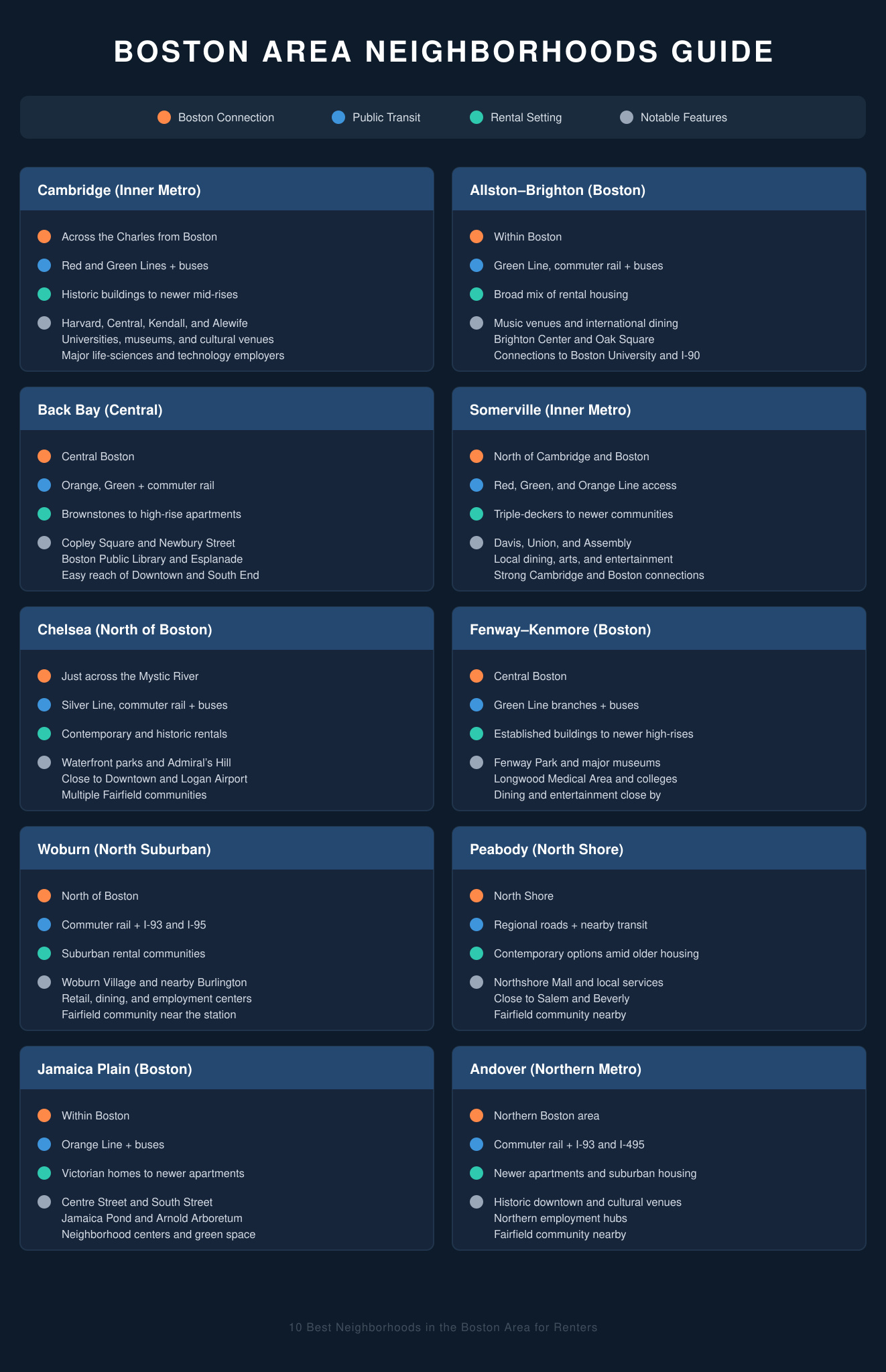
Finding Your Boston Area Neighborhood
Boston-area renters have numerous meaningful choices. Cambridge, Back Bay, Fenway–Kenmore, and Somerville keep major institutions and central employment districts close. Allston–Brighton and Jamaica Plain are residential neighborhoods inside Boston with a wider mix of housing types, from older homes to newer apartment buildings, while Chelsea combines immediate city access with a larger supply of contemporary apartments. Woburn, Peabody, and Andover extend the search into suburban and North Shore locations.
Before choosing your ideal Boston neighborhood, compare the apartment and the surrounding area at the times you expect to travel most often. Check current transit schedules, highway access, parking arrangements, grocery options, building services, and how seasonal weather may affect your routine. A location that works well for an occasional weekend trip may feel different during a regular weekday commute.
Explore Fairfield communities throughout the Boston area, from locations close to the city to suburban and North Shore settings. Browse our Boston Metro apartments to compare locations, amenities, and current availability.
FAQs About Living in the Boston Area
What types of apartments does Fairfield offer in the Boston area?
Fairfield’s apartments for rent in the Boston Metro area include communities across urban, suburban, and North Shore settings. Floor plans, finishes, services, and shared amenities vary by community, so renters should review current listings to compare the options available at the time of their search.
Where does Fairfield have apartments in the Boston area?
Fairfield communities are located in several parts of the Boston area: Chelsea, close to the city; Woburn and Andover, north of Boston; Peabody on the North Shore; Lawrence in the Merrimack Valley; Milford, southwest of Boston; and South Walpole, near the Route 1 corridor and Gillette Stadium.
Does Fairfield offer non-smoking apartments in the Boston area?
Yes. Because community designations and availability can change, renters should search for communities in the Boston Metro using our dedicated non-smoking apartment filter., Use the non-smoking apartments page and confirm current policies on the individual community website.
Does Fairfield offer eco-friendly apartments in the Boston area?
Yes. Fairfield’s Living Green® communities may include features such as ENERGY STAR® appliances, recycling programs, water-conscious landscaping, or electric vehicle charging. Features vary by community, so renters should use the eco-friendly Boston Metro search to view current participating communities and details.
Why do renters choose Fairfield in the Boston area?
Fairfield has been creating and managing apartment communities since 1985. As an Accredited Management Organization® (AMO®), Fairfield brings decades of multifamily expertise, hands-on property management, and national operating programs to our communities. For renters, that means a professionally managed home backed by an established company focused on delivering a positive resident experience.
5355 Mira Sorrento Place,
Suite 100
San Diego, CA 92121
858.457.2123
Our Office Locations